What Provincial Credit Union wanted to learn about advice at the counter
Provincial Credit Union serves members through community branches across Prince Edward Island. It set out to make member experience what sets it apart, with more financial education, planning, and advice, in person, by phone, and online.
Before investing in advice across every channel, leadership wanted to know 2 things. Would members welcome advice during an everyday visit to the counter? And could the team deliver it with confidence?
How the project was set up, and what it had to work around
The credit union's people are the experts in their members and their branches. My part was to bring the process and run it. After a short discovery to learn the team, its goals, and its plans for member experience, I put forward an approach and led the team through it, drawing on what they knew at every step.
We agreed on the outcomes at the start: a tested way of offering members advice, and a process the team could run on its own. The project spanned several months, and the scope was framed around those outcomes while staying flexible to everyone's time and availability. The pace was set by the team's other commitments and by bringing in people from outside the core team. At every stage, up to and including the pilot, the member experience team worked through the material first to build a shared foundation, then invited others from across the credit union to give feedback.
The constraints shaped every part of it:
- Time. The member experience team was brought together for this project, and everyone on it had a full-time job. They had a few hours a week to give, so I organized the sessions and kept the project moving between them.
- Branches and teams recently brought together. The credit union had recently brought its branches and teams together as one organization, and the team wanted members to get the same service in every branch.
- Busy counters. Counters left little room for a conversation beyond the transaction.
Those constraints decided where member input came from. The early research drew on the credit union's own member survey results and on the team who serves members every day, and members' responses came directly in the pilot, where every conversation was recorded. Bringing members in before the design stage is the next step.
What the team said great member experience takes
I started with what the credit union already had: its plans, its member survey results, and its contact centre reporting. Then I interviewed 6 leaders one-on-one and ran a survey open to everyone, from member service representatives to back-office roles. More than 100 people answered it.
People described relationships and trust as the foundation. They also wanted to be proactive rather than reactive, offering advice and solutions before a member asked. As one team member put it in an interview, "Member-facing staff really know their members. Sometimes, the area for improvement is just the time piece of it."
Training came up again and again, on products and on how to start a conversation about money. Every idea that followed had to fit inside an ordinary visit, build the team's confidence, and work for members who bank online as well as members who prefer the branch.
Choosing one idea to pilot from a short list
We brought together a member experience team for this project, with people from across the credit union, so the people shaping the change included people who would deliver it.
The candidates came from the credit union's own plans for member experience: what it meant to them, and which channels it touched. Our first workshops turned those into a short list. One idea was contacting members proactively with updates. Another was training in empathetic communication. A third was offering one piece of useful financial advice at every interaction at the counter.
I recommended starting with the advice, and the team agreed. High value and low risk were among the criteria we set for a first pilot. The advice fit inside a busy visit, was reviewed internally before it reached members, and gave the team a way to build confidence one conversation at a time. We framed it as an experiment, so the team could learn the full process on something small before taking on anything larger.
The pilot was for the general counters, where members come in for everyday banking, not the counters that serve business members. A member depositing a cheque might learn how to do it from home, a member with a large balance in an everyday account might hear about savings options, and a member asking about a card might learn how to set up fraud alerts.
Designing both sides of each member conversation
I designed and ran 6 workshops with the member experience team, each building on the last. The team built empathy maps of what members say, think, and feel in a visit, turned those needs into questions worth solving, and then into specific moments where advice fits.
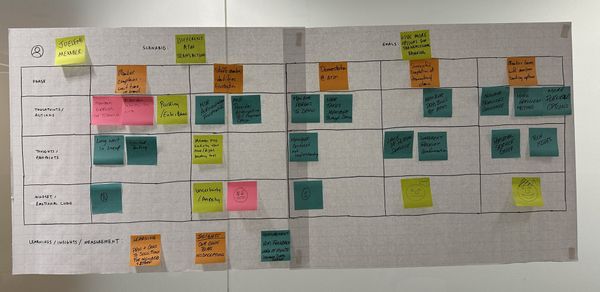
For each moment, we mapped both sides of the service together, in the way a service blueprint does. On the member's side, what they see, hear, and do. On the team's side, what they need behind the counter, from product knowledge to a way of recording the conversation.

From that, I built a framework the team could reuse to design any conversation, with a one-page guide for each one.

Testing conversations with front-line team members before members heard them
Before anything reached a member, front-line team members who weren't part of the member experience team played through the conversations, from a bill payment at the counter to a question about a card. We recorded and reviewed each session.
Watching the conversations played out taught us things the written guides didn't. Team members needed to understand why a member chose to come in before suggesting another way to bank. The words mattered too: members talk about depositing a cheque with their phone, not the product name for it. Comfort with technology varied widely, so some advice needed a quick demonstration instead of an explanation. We changed the guides and the training before the pilot started. (I wrote about how watching people use something builds a shared understanding on a team.)
Piloting financial advice at the counter
Before any branch started, the team agreed on what success looks like and how we would know. Their answers became the measurement plan. After each conversation, the team member recorded the advice offered and how the member responded: acted on it, would think about it, or not interested. Personal details were removed before anyone reviewed the data.
The pilot started with 3 kinds of conversation and grew to 11 over 6 months, a time frame set so it wouldn't overwhelm the branch teams. Each week, pilot branches answered 3 questions: what is working, what is getting in the way, and what would help. They could answer in a short survey, a call, or a recorded voice note, since people often say more out loud than they will write at the end of a shift. The member experience team reviewed the feedback weekly and took a deeper look once a month to decide whether each conversation was ready for more branches, needed changes, or should stop.
How credit union members responded to advice at the counter
Team members in the pilot branches recorded more than 770 conversations with members over 6 months.
Members acted on the advice right away in more than a third of conversations
In more than a third of conversations, the member acted on the advice during the visit. In about another third, the member said they would think about it. In the remaining quarter, the member wasn't interested, though team members noted many still appreciated being told.
Fraud protection drew the strongest response. In more than 90 conversations, from setting up alerts to locking a lost card, members acted on the advice or said they would think about it in about 4 of every 5. Large balances came next, at about 3 in 4 of nearly 130 conversations. Advice on other ways to deposit a cheque or pay a bill, more than 280 conversations between them, drew that response about 7 times in 10.

What members did with the advice
Other ways to deposit a cheque was the most common conversation, nearly 200 times. Many members didn't know they could deposit one at an ATM, and having access to the money sooner was a strong reason to try it. Some members still preferred coming in, and the team learned to ask why before suggesting a change.
Large balance conversations opened the clearest path to new business. Many members didn't know their savings options, there was strong interest in tax-free savings accounts and investments, and the pilot pointed to a better way of referring members to a financial services officer.
Conversations that rarely happened pointed to privacy and confidence
A few conversations barely came up. Credit card balances, credit scores, and overdraft protection were each offered a few dozen times or fewer in 6 months, against nearly 200 cheque deposit conversations.
The team's feedback helped explain why. These are private topics that may suit an office better than a counter, and they ask more of the person bringing them up. That pointed to training and setting, and it shaped what the team planned next.
Front-line team members found the advice easy to deliver
In the retrospective, pilot branches told us the guides and conversation starters were clear and easy to learn. They described their confidence growing over the pilot, members responding to it, and the pilot lifting morale.
One team member put it this way: "As your comfort level gets up, as you're more comfortable talking about things, people get that. If I have confidence in it, they're gonna have confidence in it."
Another saw growth on both sides of the counter: "Our members are going to grow in their knowledge. We're going to grow as staff. Really. Win, win, I think."
They also told us what would help next time: more time to practice before starting, a short video of a conversation, and recording conversations in the member system they already use, so colleagues can see what advice a member has already heard.
What the credit union and its member experience team left with
The pilot answered leadership's 2 questions. Members were open to advice during everyday visits, acting on it right away in more than a third of conversations, and the team could deliver it. The member experience team reviewed the results together, and its planning for the next phase treated advice as the standard for member service from then on.
The team left with:
- A process it had run once, start to finish, from research and workshops to testing and a pilot, documented so it could run it again: the workshop approach, the framework and guide template, the measurement plan, the weekly feedback questions, and the retrospective questions
- A baseline for member experience at the counter, alongside the member survey it already ran, from every recorded conversation
- A plan for the next round, starting with fraud protection by phone and then online, branch champions to help shape new conversations, conversations grouped by how much they ask of the team, and follow-up matched to each kind of conversation
- A different way to introduce change, where branch managers explain the reason for a change back, rather than hearing it explained to them
The member experience team took the framework over and continues testing with it.
How to pilot a change to your member experience
1. Start with one change your team can run
Pick an idea small enough to fit inside an ordinary day, and use it to learn the process together. A team that has run a full round once can run the next one without outside help.
2. Design the member's side and the team's side together
A conversation guide is only half of a service. The team also needs product knowledge, training, and a simple way to record what happened. Design both with the people who deliver the service, and the guides will sound like the people using them.
3. Test with your own team before members
Playing a conversation through with colleagues takes little time and shows you what a written guide can't. Our sessions changed the wording and the training before a single member heard the advice.
4. Agree on what success looks like before you start
Decide what you will measure, and how, before the first conversation. If you define success afterward, it is too easy to read the results to fit what happened.
5. Look at what rarely got used
The conversations that barely happened told us about privacy, comfort, and training. Ask why something was used less before deciding it didn't work.